
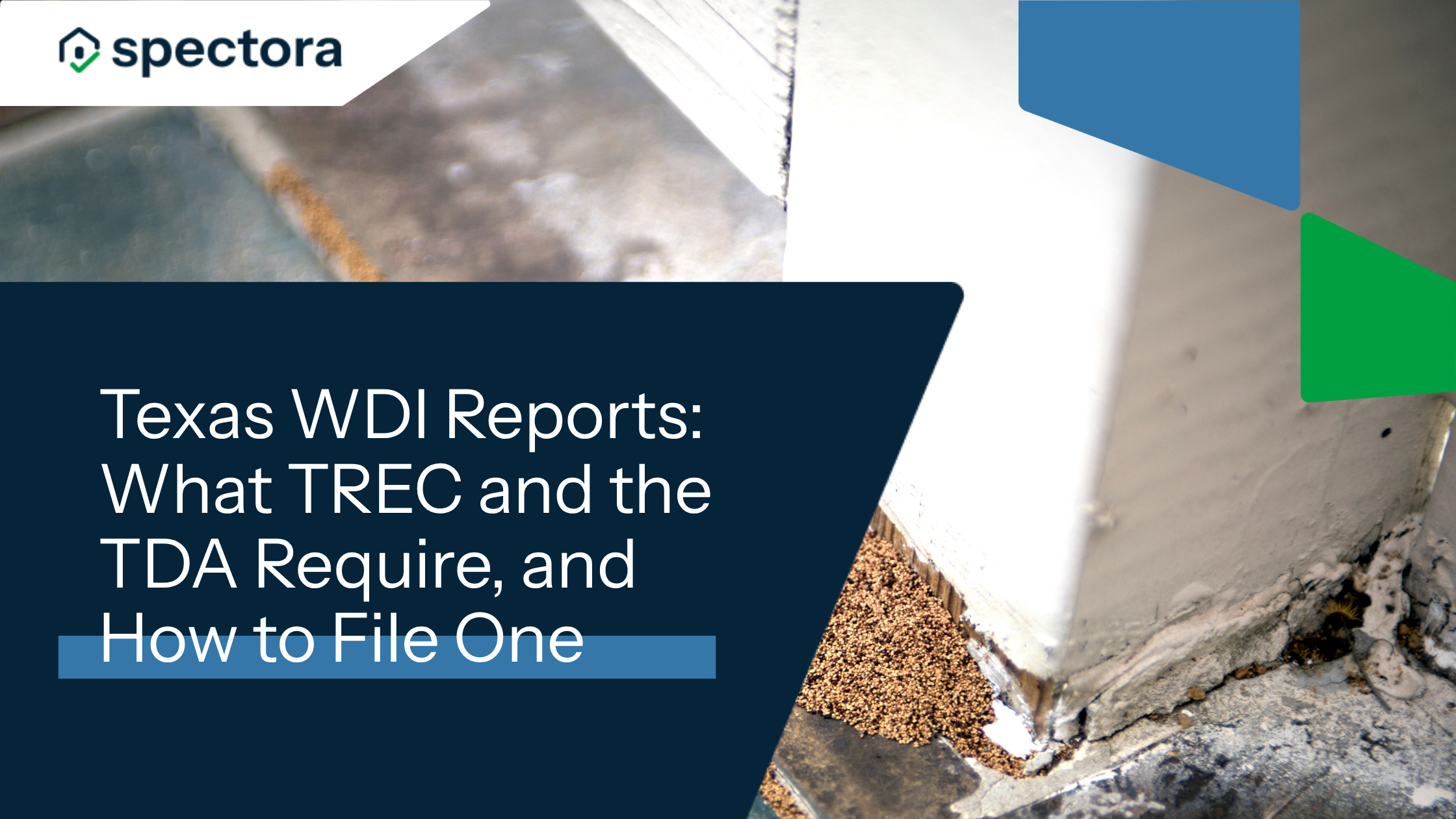
Texas WDI Reports: What TREC and the TDA Require, and How to File One
Contents
If you're a Texas home inspector starting to work residential real estate transactions, you'll quickly run into Wood Destroying Insect (WDI) inspections. Buyers ask for them. Real estate agents expect them. VA loans require them. And in regions with high termite pressure like Houston, the Gulf Coast, and East Texas, knowing how to handle the WDI side of the business is part of doing the job.
WDI reports in Texas come with their own rules, their own form, and their own licensing requirements that are separate from your TREC home inspector license. New Texas inspectors often discover this the hard way, when a referral asks for a WDI inspection and they realize they aren't actually qualified to perform one.
What a WDI report is, and why Texas buyers ask for one
A Wood Destroying Insect inspection is a property inspection focused specifically on insects that damage wood. That's primarily termites, but it also includes carpenter ants, powder post beetles, and a few others. The inspector examines the structure for active infestation, past activity, and conducive conditions like excess moisture or wood-to-soil contact.
WDI reports are commonly requested in Texas real estate transactions for several reasons:
- VA loans typically require a WDI report in states like Texas where termite pressure is significant.
- Some FHA and conventional lenders request them on a case-by-case basis.
- Buyers in high-pressure regions often ask for one independently of the lender.
- Sellers sometimes order one preemptively to address questions before a buyer raises them.
Termites make WDI inspections a routine part of many residential transactions in Texas. That includes the aggressive Formosan subterranean termite in coastal counties.
Who can perform a WDI inspection in Texas
This is the part that catches new Texas home inspectors off guard.
A TREC home inspector license does not, on its own, authorize you to perform a WDI inspection in Texas. Wood Destroying Insect inspections in Texas are regulated through the Texas Department of Agriculture's Structural Pest Control Service. The inspection has to be performed by someone licensed under that program, typically a Certified Applicator or Technician with the appropriate Wood Destroying Insect category.
Some Texas home inspectors hold both credentials: a TREC home inspector license and a TDA structural pest control license with WDI authorization. That combination lets them perform both the home inspection and the WDI inspection in the same visit, which is a real efficiency for the inspector and a convenience for the buyer.
Inspectors who don't hold the WDI credential typically partner with a licensed pest professional and either coordinate the visit or refer the work out. Either approach is normal. Assuming your TREC license covers WDI is a mistake worth catching before you make it in front of a client.
If you're considering adding WDI authorization to your practice, the path runs through the TDA, not TREC. The licensing pathway includes coursework, an exam, and continuing education. Requirements can change, so anyone pursuing this should check directly with the TDA's Structural Pest Control Service for current rules and fees.
Additional resources for Texas Licensing requirements can be found here.
What goes in a Texas WDI report
The Texas WDI report has its own standard form, separate from the TREC REI 7-6. It documents:
- The property inspected, including address, date, inspector identification, and license number
- The structures included in and excluded from the inspection
- Areas of the property that were inaccessible or obstructed (a common note for crawlspaces, finished basements, storage areas, or built-ins)
- Observations of visible evidence of wood-destroying insects, including active infestation, previous infestation, or damage
- Conducive conditions that promote infestation, such as excess moisture, wood-to-soil contact, and debris under structures
- Findings, treatment recommendations if any, and inspector signature and licensing information
Photos are typically expected for any findings of evidence or active infestation. Clear locational notes (which area of the structure, what was observed) are what make a WDI report defensible if questions come up later.
Common WDI findings in Texas
A few patterns worth knowing if you're new to WDI work in Texas:
- Subterranean termite mud tubes on foundation walls, especially on slab-on-grade construction.
- Termite damage in baseboards, door frames, and window sills. These are areas where wood contacts or sits near moisture sources.
- Formosan termite activity in coastal and Gulf-region homes, which can be more aggressive than native subterranean termites.
- Conducive conditions: wood mulch piled against siding, scrap lumber under porches, irrigation lines that wet siding regularly.
- Drywood termite evidence in older homes, particularly in parts of South Texas.
A clean WDI report doesn't just check boxes. It gives the buyer and the lender a clear picture of risk, and it documents what was and wasn't visible during the inspection. Inaccessible areas (a finished basement, an obstructed crawl, a permanent built-in cabinet) should be explicitly noted.


Setting up an efficient WDI workflow
If you hold the WDI credential and you're performing inspections regularly, a few practices keep the workflow manageable:
- Use a templated WDI report. Like the REI 7-6, the WDI form has a standard structure. Rebuilding it for every inspection is wasted time.
- Document conducive conditions, not just active findings. A clean report that notes conducive conditions is often more useful to a buyer than one that just says "no active termites observed."
- Coordinate the WDI with the home inspection when possible. If you're doing both, the efficiency of one site visit is real. Make sure the report timelines and delivery match what the buyer's agent expects.
- Keep photo evidence organized by area. Crawlspace, exterior, attic, garage. Labeled photos save you time if a question comes up two weeks later.
How template software fits in
Spectora's Template Library includes a Wood Destroying Insect form alongside the TREC REI 7-6. For Texas inspectors who hold both credentials, having both forms in the same platform means one workflow, one set of photos to manage, and one delivery to the client.
A quick checklist for a Texas WDI report
Before delivering a WDI report, confirm:
- You hold the appropriate TDA license category for WDI work (or you've partnered with someone who does)
- The property identification is complete and matches the lender's expectations
- Areas inaccessible during the inspection are explicitly noted
- All findings (active, previous, damage, conducive conditions) are documented with locations and photos where applicable
- Treatment recommendations, if any, are clear and within scope
- The report is signed and licensing information is filled in
WDI inspections aren't complicated once the workflow is in place. The licensing pathway is the first thing to get right. The form itself follows familiar patterns once you've filed a few. For Texas inspectors building a multi-service practice, having both TREC and WDI credentials, along with a software workflow that handles both forms, is one of the more efficient ways to grow.
The TREC REI 7-6 and the Wood Destroying Insect report are both pre-built in Spectora's Template Library. Add them once, use them on every Texas inspection.