
How to Price Your Home Inspection Business (Without Guessing)
-1.png)
Contents
Quick answer: Price using a combination of two methods — a billable-hours formula that covers salary, overhead, and profit, checked against local market rates. National averages currently run $296–$424 per inspection, but the right number for your business depends on your costs, not your competitor's website. The fastest way to land on a real number: run your numbers through Spectora's free pricing calculator.
What Home Inspectors Actually Charge in 2026
Before you set a number, it helps to know where the market sits. Based on HomeAdvisor data from October 2025, the average home inspection costs $343–$344, with most homeowners paying between $296 and $424 (Angi, Rocket Mortgage). A separate industry analysis puts the average closer to $377, with a normal range of $200–$500.
Square footage is still the biggest driver of price:
| Home Size | Typical Cost |
| Under 1,000 sq ft | $200–$250 |
| 1,000–1,500 sq ft | $225–$325 |
| 1,500–2,000 sq ft | $250–$375 |
| 2,000–2,500 sq ft | $275–$400 |
| 2,500–3,000 sq ft | $300–$500 |
Source: Angi, Rocket Mortgage
Location and add-ons swing the number further — city averages range from $300 (Miami) to $450 (New York), and specialty add-ons like radon ($250 avg), mold ($660 avg), and sewer scope ($270–$1,734) each carry their own pricing.
But those numbers are already behind the curve. Spectora's 2026 Industry Report — survey data from 429 inspectors and 433 agents, plus platform-wide quote data — found the national average inspection quote jumped from $457 to $569 in 2025, a 25% increase, and 52% of inspectors raised their prices, a trend that held across every U.S. region. If your fee hasn't moved in that window, you're not being conservative — you're falling behind a market that's already re-pricing itself around you.
None of this tells you what you should charge. It tells you what the market allows, which is one input, not the whole formula.
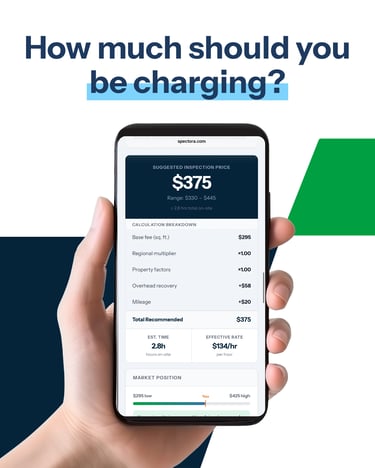
See where your fee should actually land. Enter your square footage, region, and monthly overhead into Spectora's free pricing calculator for a suggested price built from real cost data, not a guess.
Two Ways to Set Your Fee
InterNACHI teaches inspectors to price using two methods, then reconcile them (NACHI.org):
Billable hours: (Desired salary + overhead + profit) ÷ annual billable hours = your rate. InterNACHI's own example: an inspector targeting a $100K salary, $25K overhead, and 20% profit needs $156,250 a year. At 1,250 billable hours, that's $125/hour — $625 for a typical five-hour job.
Market-based: Check what comparable local inspectors charge (try InterNACHI's InspectorSeek) and calibrate around it.
If your billable-hours number lands higher than the local market, that's not a signal to slash your price — it's a signal to build the case for why you're worth it. If it lands lower, you likely have room to raise prices before you lose a single client.
Price Isn't What Wins You Referrals
Nearly 8 in 10 inspections come from agent referrals (Spectora 2026 Industry Report), which makes it worth knowing exactly what makes an agent refer one inspector over another. Price ranks dead last:
| What Agents Weigh | % Citing as Top Factor |
|---|---|
| Accuracy and thoroughness of inspection | 53% |
| Clear, easy-to-understand reports | 48% |
| Professional communication with buyers | 47% |
| Reliability and timeliness | 46% |
| Post-inspection buyer support | 17% |
| Price of the inspection | 7% |
Source: Spectora 2026 Industry Report, Agent Survey, N=433.
Agents protect their own reputation with buyers — they refer whoever makes them look good, not whoever is cheapest. Being thorough, clear, and easy to work with buys you far more pricing room than being the cheapest name on the list.
Price Psychology That Actually Works
- Anchor before you quote. Mention what an undiscovered issue typically costs to fix (a cracked foundation, a failed roof) before you state your fee. Against a five-figure repair, a few hundred dollars reads as cheap insurance, not an expense.
- Frame it as protection, not a cost. "You'll know exactly what you're buying before you're on the hook for it" lands harder than "I charge $400 for an inspection." Loss aversion means people work harder to avoid a bad surprise than to chase a discount.
- Offer three tiers, not two. A single price invites a yes/no decision. A "standard / standard + radon / standard + radon + sewer scope" structure gives clients a middle option that feels like the obvious pick.
Common Pricing Mistakes and the Fix
- Pricing off competitors instead of your own costs. You inherit their mistakes along with their numbers. Run your own overhead and profit target through a calculator first.
- Giving away add-ons. Radon, sewer scope, mold — each should be its own profitable line item. Bundle for convenience, don't discount for free.
- Letting your rate sit still. Overhead, insurance, and fuel costs rise every year even when your price doesn't.
- Quoting a number with no context. A price with no stakes attached is just something to compare against the next inspector's number.
- Raising prices without building the capacity to back it up. Inspectors using AI tools for scheduling, communication, and reports are 20% more likely to have raised prices in the past year (58% vs. 38% of non-adopters) — efficiency creates the confidence to charge for the value delivered (Spectora 2026 Industry Report).
Price Your Next Inspection With Real Numbers, Not a Guess
Cost recovery, market checks, add-on pricing — it all comes together in one place. Spectora's free pricing calculator builds a suggested fee from your square footage, region, competition level, and actual monthly overhead, with a full line-by-line breakdown.

FAQ
How much should I charge for a home inspection? National averages run $296–$424 for a standard single-family home (Angi), but your fee should be built from your own overhead, desired salary, and profit target, then checked against your local market. Spectora's pricing calculator does this math for you.
Should I charge a flat rate or price per square foot? Most inspectors use a flat rate up to about 2,000 square feet, then add roughly $25 per additional 500 square feet (Angi).
Are home inspectors actually raising their prices right now? Yes. The national average inspection quote rose from $457 to $569 in 2025 — a 25% increase — and 52% of inspectors raised their prices in the past 12 months, across every U.S. region (Spectora 2026 Industry Report).
Does charging more risk losing agent referrals? The data says no — only 7% of agents cite price as a top referral factor, while accuracy (53%), clear reports (48%), and communication (47%) top the list (Spectora 2026 Industry Report).
How do I know if I'm underpriced? Compare your billable-hours rate (salary + overhead + profit ÷ annual billable hours) to what you're currently charging. If the calculated rate is higher, you're underpriced relative to your own costs — regardless of competitors.